Artificial intelligence (AI) is no longer a futuristic concept — it has fast become one of the most debated elements of the U.S. economic landscape. From Wall Street to Washington and beyond, economists, policymakers and investors are grappling with how AI is influencing growth, productivity, labour markets and national economic strategy in 2026. What was once primarily a technology story has evolved into a multi‑faceted economic narrative with global implications.
AI’s Contribution to Growth: Real or Overstated?
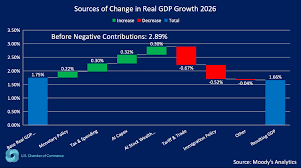
In 2025, the United States recorded modest GDP growth, with overall economic expansion around 2.2% for the year and a slower 1.4% pace in the final quarter. In many analyses, investment related to AI infrastructure — especially data centers, computational hardware and related software development — was highlighted as a significant driver of this growth. Some estimates suggest AI‑related investment accounted for around 0.4 percentage points of GDP growth in 2025 and could contribute a similar share in 2026, translating into roughly $200 billion in direct economic activity.
However, economists differ sharply on how meaningful this impact really is. Critics argue that while spending on AI infrastructure boosts measured output — particularly in construction and equipment — it doesn’t necessarily reflect widespread productivity gains across the broader economy. Some scholars suggest that much of the investment is concentrated in a handful of large tech firms and may inflate GDP without substantially raising living standards or broad economic participation.
The debate became particularly pronounced following a popular commentary in The Washington Post, which described the narrative that “AI drove massive economic growth” as potentially a mirage, pointing out that much AI expenditure flows into imported components and infrastructure projects with delayed or indirect productivity benefits.
Productivity, Measurement and the Limits of GDP
One of the central challenges in assessing AI’s economic contribution is the inadequacy of traditional metrics like gross domestic product (GDP). As U.S. and global leaders in technology research have noted, GDP is not fully capable of capturing intangible value such as improvements in quality of life, creativity, or efficiency gains from digital tools.
For instance, while AI may improve the speed of data analysis, enhance decision‑making and reduce operational costs across sectors, these improvements often manifest in forms that don’t register immediately as output in national accounts. This gap has led some economists and tech leaders to argue that new measurement frameworks are needed to understand the real economic value of digital technology in the 21st century.
Employment Dynamics: Jobs Creation vs. Displacement
AI’s impact on jobs is equally complex. Traditional economic models predicted that automation would displace certain roles while creating new ones. Recent data indicate that heavy investment in AI has coincided with slowing job growth — particularly in sectors tied to traditional tech employment. Some economists even argue that advances in automation have already displaced certain positions, complicating the job market picture.
Yet the picture is not solely one of job loss. AI adoption appears to be reshaping labour demand rather than eliminating it wholesale. For instance, a study by Oxford Economics suggests that while unemployment may rise in highly AI‑exposed occupations, much of this change reflects broader labour supply dynamics rather than direct AI‑driven layoffs. Meanwhile, other research points to AI boosting productivity among skilled workers, suggesting that workers with advanced skills could see disproportionate gains.
Monetary Policy and AI: Not a Shortcut to Rate Cuts
The debate over AI’s broader economic influence extends into monetary policy. Recent remarks by officials of the Federal Reserve highlighted skepticism about AI serving as a reason for lowering policy interest rates. One senior Fed governor argued that, although AI’s long‑term contributions are likely positive, short‑term disruptions and costs — such as increased energy demand from data centers — may even be inflationary, complicating central bank decisions on interest rates.
This position contrasts with more optimistic assessments, which claim that AI’s potential to enhance productivity could eventually support structurally lower inflation and justify accommodative monetary policy. The divergence underscores the uncertainty within policymaking circles about how technological transformation interacts with macroeconomic fundamentals.
Long‑Term Prospects and Structural Shifts
Looking further ahead, most analysts agree that the true economic impact of AI will likely unfold slowly over decades rather than within a single fiscal year. Projections from research initiatives suggest that AI could account for meaningful productivity boosts and substantial economic transformation by the 2030s, assuming widespread adoption and improved measurement approaches that better capture digital value.
At the same time, concerns about overvaluation in AI markets persist, with some commentators warning that intense investor enthusiasm may have created an AI “bubble” in certain sectors, particularly technology stocks whose valuations outpace fundamental earnings and revenue growth.
Conclusion: AI’s Role Is Evolving, Not Decided
Artificial intelligence stands at the crossroads of technological innovation and economic development in the United States. As 2026 progresses, its role remains both promising and contested. Investment has become a backbone of economic activity in certain sectors, yet whether that investment translates into broad‑based productivity gains or sustainable growth remains an open question.
What is clear is that AI has reshaped economic narratives, challenging policymakers, analysts and businesses to rethink traditional approaches to growth, jobs and productivity measurement. How the U.S. navigates this transformation — balancing optimism with realism — will significantly influence its economic trajectory over the approaching decade.